Showing posts with label Martial Arts. Show all posts

Tuesday, November 8, 2016

Martial Arts and Extremism

             Martial arts and extremism have often gone hand-in-hand. Of course, extremism is a relative term, so we will attempt to use it in the sense that is closest to "militantism". Martial (pertaining to war)  thought is often a strong draw to these kinds of groups. From skinheads to anti-racists, from ultra-nationalists to anarchists, martial arts has drawn them all to a certain type of lifestyle that tends to embrace some form of martial art or martial attitude.

 While the terms "martial arts"and "extremist" may leave a reader with a strange image of a terrorist sporting a turban in a gi and a karate headband , part of this is because the term "martial art" has, in many ways, lost its meaning to English speakers. Tto speakers of other languges, the terms fit well together. Terms such as "Kampfkunst", "Боевы́е иску́сства", "dövüş sanatlar", and "arte marcial" have far more gritty connotations to the native speakers of their respective tongues.These are terms that translate to the "art of fighting" - A.K.A "How to Fight".  Not so silly now, is it?

   One of the more historically documented ties between a very popular martial art and militants is actually the popular sport of "Krav Maga". Imrich Lichtenfeld, a devoted Zionist, applied his martial arts skills to develop a fighting style that Jews, and later on the Israeli Defense Force, would use to defend themselves and have the upperhand in close-range urban combat that Israel would be involved in for decades.


     In the US and in Europe, MMA has become a training ground for skinheads and ultra-nationalists. Shaved heads are not an uncommon sight at both gyms, as well as MMA tournament events. In Russia, which ironically has the most Neo-Nazis on earth, MMA, boxing, and wrestling is used to train initiates to skinhead and ultra-nationalist gangs for street combat. In Germany, "Wehrsportgruppen" (defense-sport groups) formed to combat increased crime from immigrant groups in working-class areas. Certain clothing brands have decided to even openly promote the ties between ultra-nationalists and MMA - like "White Rex", for example. Other brands, such as Doc Martens, Lonsdale, and even Adidas have struggled with this image, as well.
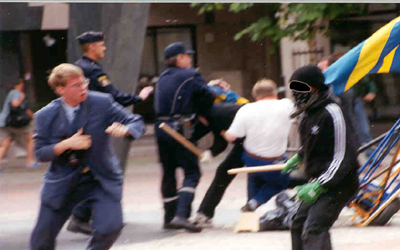


    On the other end of the spectrum, antifascist groups and anarchists have also adopted martial arts. One must look only at the "Anarchist's Cookbook" to see advice on how to fight, weak points of the body to strike, and more. These groups encourage their followers to seek training in martial arts. Sometimes they offer "workshops" for improving fighting skills. Their reasons? The same as the far right - preparing for street combat, except against police and their own perceived enemies, just as the skinheads would combat immigrant gangs.

Why are all these radical groups practicing martial arts? The reason may seem simple - "Duh, they want to know how to fight, stupid!"

                                                                          WRONG


It is more complex than this. If these radical groups wanted to truly want to know how to "fight to win", so to speak, they would be spending more time on classes dealing with knives, bombs, weapons, infangry tactics, assassinations, and other deadly methods. These are the methods used to topple governments, destroy enemies, and generate public attention. Let's be honest - a gun tends to trump a punch, and an untrained soldier with a rifle can often easily kill a trained martial arist. Martial arts are promoted because they teach a lifestyle of self-sacrifice. To suffer now is to make a sacrifice for the greater good of tomorrow. For many extremist groups, this is the goal in mind.

Friday, June 8, 2012

3 Ways to Improve your Roundkick

The roundhouse kick is the basis of most kicking arts


Number One: Hold Your Kick


Holding your kick is a very important aspect in building strength in the muscles required to kick effectively.  You should at least be able to hold a steady position on one leg, with the other raised in the air. The next step should be to chamber the kick and hold the chambered position for at least 30 seconds After having mastered that, practices holding out the leg extended in the manner you would strike an opponent for at least 10 seconds. The final step is to be able to perform the entire kicking motion in complete fluidity over a period of at least 15 seconds.


Number Two: Keep Your Back Straight

Too many newcomers to kicking arts tend to hunch over as they kick. This gives the illusion of being able to generate more power, just as winding up a punch makes your cross or hook feel stronger. In reality, hunching over and winding up completely telegraphs your motions to your opponent. You should be able to kick quickly and without warning from a standing position. Keeping your back straight and your center of gravity directly below you also gives you a better range, as well as making it easier to retreat in case your opponent evades the attack. However, avoiding leaning back, as this exposes the chin.


A straight back also allows you to keep a better defense, by protecting your head with your arms, as well as allowing you to clearly see your opponent.


Number Three: Drop Your Kicks

Now that you can hold your kicks, it will be almost counter-intuitive to drop them as fast as possible. While practicing slow kicks may have increased your technique and power, it also leaves your kick vulnerable to grabs and takedowns. Practice your kicks as you usually would, but now drop them to the ground as fast as possible after hitting the target. Initially stomp them down right next to the target, but slowly begin to attempt to drop them closer to their original starting position. This may sound easy, but it is incredibly difficult if done with a straight back and proper technique, as well as speed. This is best combined with speed training.


Good luck training!

Sunday, January 15, 2012

Head Kicks vs Body Kicks: Playing it Safe


           Taekwondo lays a massive emphasis on kicks that are fast, long reaching, and high. In WTF sanctioned competitions, kicking to the head is rewarded with more points, not to mention that the judges will probably score your kicks more often after seeing you are capable of dealing damage and not a pushover.

As flashy and cool as these kicks may seem, sometimes good old fashioned body kicks will get the job done better and land points far more consistently.

Which ones should you use? Both, if possible. However, a Taekwondo fighter should mix and match the ratio of high kicks to body kicks in a manner that suits their needs and the current situation at hand.

Here is a short list comparing the two methods:

Head Kicks
Pros:
  • More points- Headkicks will always receive more points than a standard kick to the ribs or the chest. 
  • Knockout- The possibility of a knockout is comparatively FAR higher than powerful body shots.
  • Intimidation- Facing an opponent who regularly throws high kicks can be daunting, especially to inexperienced fighters. This applies to sparring as well as a possible scenario on the streets.
  • Diversification- Tossing just body kicks will result in your combinations becoming predictable. Headkicks will cause your opponent to think more and worry about what your next move is.
Cons:
  • Balance issues- Without proper training, a beginner will have problems maintaining balance during a high kick, let alone returning to a proper fighting position afterwards. 
  • Vulnerability- While in the middle of a high kick, you have little to no options when it comes to protecting yourself. Your supporting leg is wide open to unintentional (or intentional) low kicks. Your head may come closer to the ground, allowing kicks aimed at the body to hit you in the head. 

Body Kicks
Pros:

  •   Consistency- Landing body shots to the chest protector is far more common than landing head shots. On average, you should be able to score more points using this method.  
  • Speed- The foot with which you were kicking can quickly be dropped right next to your opponent in order to fire another kick in rapid succession.
  • Solid base- Your foot remains closer to your center of gravity for the majority of the kicking process, especially the chambering sequence.  This means you can pull your foot back faster if something goes wrong.
 Cons:

  • Predictability- Throwing almost 100% body kicks will result in an opponent that will know where to protect themselves, as they will not have to worry about their head.
  • Little Chance of Knockout- This is self-explanatory. Incredibly powerful blows will be needed to achieve a TKO through the sparring chest protector.


I personally use a ratio of about 3/4 body kicks to 1/4 high kicks, not including when I see an opening for a headkick by chance that I can exploit.