Friday, December 22, 2017

Arriba! Andale! Ap-chagi! Taekwondo in Mexico


  As has been covered before on this website, Taekwondo is one of the fastest growing sports on the planet, but one place in particular has been caught by the fever - Mexico. The signs should have been clear - Mexico had already been a hotspot for other martial arts and had been producing boxing champions for years. One of the tipping points definitely came about when more than 4,000 spectators came to see the Kukkiwon's exhibition in Mexico City. FOUR THOUSAND. Most Taekwondo events in large American cities are lucky to pull in a few hundred, or perhaps a thousand, people, and that is including both participants and the spectators.

Mexico has over 1.5 million practitioners of Taekwondo, close to 4,000 registered schools, and is currently ranking as the country with the 4th most medals in Taekwondo at the Olympics. Considering the relatively longer time it took Taekwondo to become popular in Mexico (only really starting to kick off in the early 2000s), Taekwondo still has a bright future full of excellent growth opportunities in Mexico. No wonder large companies such as Adidas have jumped in to act as sponsors for Mexico's FMT (Federacion Mexican de Taekwondo).

A growing population, growing interest in Taekwondo, and a growth in martial arts-related talent can only spell success for Mexico's future in the ring.

Thursday, November 17, 2016

Gun Disarms Don't Work


       Direct your attention to the video above. While this is a great video, it demonstrates one of the biggest flaws in Krav Maga training - the idea of the "gun disarm". While it is recommended to watch the whole video, the uploader decides to test some of the gun disarms at about the 11 minute mark. He uses an airsoft pistol at close range to attempt to test reaction times of both himself and the shooter. As you can see in the video, there are various results. He is successful at times, but receives a painful sting more than once. 

Let's compare the velocity of an airsoft pistol and some common firearm rounds that can be found in military or street situations:

Airsoft

  • 110 metres per second (350 ft/s) and under for Close Quarters Battle (CQB)
  • 120 metres per second (400 ft/s) and under for outdoor play with fully automatic AEGs
  • 120–140 metres per second (400–450 ft/s) for semi-auto "DMR" style AEGs
  • 140–150 metres per second (450–500 ft/s) for bolt-action sniper rifles


Common Firearms
  • 1,279.5 ft/s (390 m/s) for a H-Point C-9 with 9mm Luger
  • 825 ft/s (251 m/s) for a 1911 in .45 ACP
  • Between 1,067 m/s (3,500 ft/s) and 1,524 m/s (5,000 ft/s) for most small-arms

Do you really want to try your chances with a gun to your chest over your wallet, a stupid argument, or a car jacking? The video shows that there are already mixed results while using airsoft. What do you think your chances are with bullets that are traveling nine to ten times faster? 

Tuesday, November 8, 2016

Martial Arts and Extremism

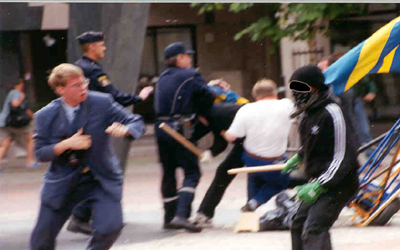
             Martial arts and extremism have often gone hand-in-hand. Of course, extremism is a relative term, so we will attempt to use it in the sense that is closest to "militantism". Martial (pertaining to war)  thought is often a strong draw to these kinds of groups. From skinheads to anti-racists, from ultra-nationalists to anarchists, martial arts has drawn them all to a certain type of lifestyle that tends to embrace some form of martial art or martial attitude.

 While the terms "martial arts"and "extremist" may leave a reader with a strange image of a terrorist sporting a turban in a gi and a karate headband , part of this is because the term "martial art" has, in many ways, lost its meaning to English speakers. Tto speakers of other languges, the terms fit well together. Terms such as "Kampfkunst", "Боевы́е иску́сства", "dövüş sanatlar", and "arte marcial" have far more gritty connotations to the native speakers of their respective tongues.These are terms that translate to the "art of fighting" - A.K.A "How to Fight".  Not so silly now, is it?

   One of the more historically documented ties between a very popular martial art and militants is actually the popular sport of "Krav Maga". Imrich Lichtenfeld, a devoted Zionist, applied his martial arts skills to develop a fighting style that Jews, and later on the Israeli Defense Force, would use to defend themselves and have the upperhand in close-range urban combat that Israel would be involved in for decades.


     In the US and in Europe, MMA has become a training ground for skinheads and ultra-nationalists. Shaved heads are not an uncommon sight at both gyms, as well as MMA tournament events. In Russia, which ironically has the most Neo-Nazis on earth, MMA, boxing, and wrestling is used to train initiates to skinhead and ultra-nationalist gangs for street combat. In Germany, "Wehrsportgruppen" (defense-sport groups) formed to combat increased crime from immigrant groups in working-class areas. Certain clothing brands have decided to even openly promote the ties between ultra-nationalists and MMA - like "White Rex", for example. Other brands, such as Doc Martens, Lonsdale, and even Adidas have struggled with this image, as well.


    On the other end of the spectrum, antifascist groups and anarchists have also adopted martial arts. One must look only at the "Anarchist's Cookbook" to see advice on how to fight, weak points of the body to strike, and more. These groups encourage their followers to seek training in martial arts. Sometimes they offer "workshops" for improving fighting skills. Their reasons? The same as the far right - preparing for street combat, except against police and their own perceived enemies, just as the skinheads would combat immigrant gangs.

Why are all these radical groups practicing martial arts? The reason may seem simple - "Duh, they want to know how to fight, stupid!"

                                                                          WRONG


It is more complex than this. If these radical groups wanted to truly want to know how to "fight to win", so to speak, they would be spending more time on classes dealing with knives, bombs, weapons, infangry tactics, assassinations, and other deadly methods. These are the methods used to topple governments, destroy enemies, and generate public attention. Let's be honest - a gun tends to trump a punch, and an untrained soldier with a rifle can often easily kill a trained martial arist. Martial arts are promoted because they teach a lifestyle of self-sacrifice. To suffer now is to make a sacrifice for the greater good of tomorrow. For many extremist groups, this is the goal in mind.

Friday, October 9, 2015

Worse than Nothing


Believe it or not, a few things are actually worse than nothing! A worthless item that gives one a false sense of confidence puts you at substantial risk. Many people would actually freeze upon being confronted with a rapidly unfolding crisis scenario and discovering that the one thing they were relying upon to protect them had failed. Do not give any of these bogus "defensive measures" a second thought. Can they work? Yes. Should you bet your life on it? Hell no.


1.) STUNGUN: These silly toys consistently fail to perform as advertised. They are only useful for torturing helpless victims, which makes them worthless to everyone but sadists. They are only effective when forcibly held against sensitive areas for 10 seconds or longer, which is nearly impossible to achieve versus a physically superior assailant. Tasers and stun batons are a little more effective, but not much. Do they hurt? Yes. However, you might need to administer far more than just simple pain.

2.) DEFECTIVE PEPPERSPRAY: Pepperspray (as well as teargas) canisters are offered by dozens of manufacturers — unfortunately, many of them prove to be of poor quality. Poor quality pepperspray dispensers may fail to function due to jammed buttons, internal misalignments, or other manufacturing defects. Furthermore, canisters could be empty, depressurized, or filled with a weak solution. Be certain that you buy only top quality products, keep the nozzle free of debris (like pocket lint), and discard after the expiration date — don’t trust your life to some imported pepperspray that you found on sale at a convenience store.

3.) HOME FABRICATED SPRAY WEAPONS: These are often completely ineffective. Homemade solutions with onion juice, peppers, tobasco sauce, etc should be avoided. It's dangerous to promote these ideas.

4.) FAKE GUNS: Some idiots actually carry toy guns, gas guns, model guns, and replicas in hopes of "frightening" a potential mugger or rapist. It is dangerous to bluff when your life is at stake, especially when a bold assailant might be tempted to wrest it away from you, knowing many people have a tendency to hesitate or "freeze up" upon realizing they might actually shoot someone. If an assailant discovers he’s been threatened with a harmless prop, it is likely he’ll become enraged and beat you severely. Furthermore, possession of fake guns is unlawful in many jurisdictions and numerous countries.

5.) HATPINS: A sturdy hatpin can inflict serious injuries if precisely stabbed deep into vital areas; however, wounds caused by such a weapon will not effect an assailant’s ability to fight until much later . . . perhaps hours later. Being stabbed with a hatpin will only serve to enrage an attacker, and they tend to bend or break quite easily. This flimsy "weapon" (as well as similar objects) has imbued many novices with a false sense of confidence.

6.) KEYS PROTRUDING FROM FIST: Many self-defense manuals advocate grasping one’s keys in the fist so that they protrude from between the fingers in a clawlike fashion. In theory, this appears to be a good idea; but in practice, the keys are uncomfortable to hold in such a manner (as well as difficult to get into position quickly) and are unsecured, resulting in their twisting and pivoting upon contact with one’s target. Twisting and pivoting of the unsecured keys can easily lacerate one’s fingers, resulting in possible muscle and nerve damage. One’s keys should never be used in this manner.

7.) NAILFILE: Most metal nailfiles, although having a pointed tip and perhaps even a small handle, are far too flimsy to stab a person without bending or breaking. While it might be unpleasant to be jabbed with one, this flimsy weapon would only be effective versus the eye, groin, or throat.

8.) BROKEN BOTTLE: The broken bottle is probably the improvised weapon most often brandished in various action-adventure films, and broken glass is considered to have one of the sharpest edges known to man, so most people reasonably assume that by simply busting off the end of a handy bottle they will instantly be armed. . . unfortunately, this is seldom the case. First, many bottles are extremely difficult to break — you can literally smash a bottle against the edge of a table several times with the only result being a chipped table; Second, the bottle could shatter in your hand, leaving you injured as well as weaponless; Third, you could easily catch a piece of broken glass in one of your eyes, impairing your ability to fight and possibly even resulting in irreparable blindness; and Finally, if you do succeed in breaking the bottle without injuring yourself, chances are that you will only be holding the bottle’s neck with a little bit of jagged glass at the end — a weapon lacking in both range and intimidation value. If the only improvised weapon available to you is a bottle, I’d recommend leaving it intact for use as a bludgeon, possibly smashing against your opponent for maximal damage. The bottles broken on television shows are specially designed to be broken in such a manner — usually by first selecting a specific type of glass bottle and then weakening it with a blowtorch — please do not attempt to replicate the falsehoods seen on television with the expectation that they will work in reality.

9.) IMPROVISED "FLAMETHROWER": Not only has this fantasy weapon been featured in many action-adventure films, but it has also been endorsed by numerous underqualified "self-defense experts." Typically, an aerosol can filled with spray paint, hairspray, or WD-40 is sprayed across an open flame (usually from either a lighter or a burning cigarette), igniting the flammable droplets in an impressive fireball. Anyone touting this foolishness as "effective" is an imbecile. Not only are the droplets consumed instantly (resulting in minimal range and little chance of seriously burning an adversary), but there is a significant risk of the flame entering the cannister and detonating, engulfing the sprayer in flames and peppering him with shrapnel. NEVER ATTEMPT THIS!

10.) WHISTLES AND ALARMS: A determined attacker will immediately snatch this away from you and smash it. It is unlikely to attract help, but is sure to piss off your attacker. They also very irritating and will further anger an attacker.

11.) "YUCKY STUFF": "Ewww . . . stay away, or I’ll wipe this on you!"  KINDERGARTEN IS OVER, GUYS. THE POOP STICK DOESN'T WORK ANYMORE. Some emotionally stunted imbeciles seem to think that the threat of having sludge, slime, raw egg, pudding, rotting garbage, or a "dog turd on a stick" dirty the clothes of an attacker will actually make him reconsider targeting them; however, the far more likely result is that the attacker will instead pummel the naive fool into whimpering submission before gleefully force feeding him the substance in question. What worked on the schoolyard bully in 3rd grade will hardly faze a degenerate crackhead who wallows in squalor under downtown bridges. The only things in this category that possess any intimidation value at all are infected needles and toxic waste.

12.) APPEALING TO INNER GOOD: If you are spared a  beating, it is because they felt it was not in their best interests to waste their time dishing one out.. Muggers are predators who perceive those weaker than themselves to be nothing more than mealtickets and playthings, and nothing you can say will alter this fact.

13.) ASSERTIVENESS: If you haven’t got anything to back up your cocky attitude, you could easily turn a simple mugging into a serious stomping — and you would probably deserve it. An offended predator will feel compelled to "put you in your place" through whatever means necessary, which will probably result in your being maimed or killed. Predators very much resent being condescended to or threatened by those they perceive as weaker than themselves, and will gladly take the extra time to hurt such a person even when it does not appear to be in their best interest to do so. Don’t pretend to be a "tough guy" if you’re not . . . you’ll be fooling no-one but yourself.

14.) SUBMISSIVENESS: The mugger might simply take what he wants (belongings, money, dignity, sexual release) and leave without stomping you into a coma, or he may choose otherwise. Some deviants would feel a thrill at the seemingly unlimited control they suddenly had over another human being and might decide to "make the most of it" (ending in torture and murder), while others might loathe your pathetic weakness and decide to punish you. If you choose to go totally submissive, you are willingly permitting the attacker in question to decide your fate. . .do you feel he will act responsibly? Fight, flee, or negotiate, but never allow your future to depend solely on the whim of some degenerate criminal. If you are unable to make important decisions about your own future, others will be happy to make them for you — usually being sure to take full advantage of your weakness.

Tuesday, October 6, 2015

Taekwondo in MMA

 Taekwondo is ineffective! Taekwondo is overrated! Taekwondo kicks aren't viable! All MMA fighters use Muay Thai as their striking style!

How often have you heard these claims thrown about? We assume you've heard it more than enough. Are these claims true? In short, no. Let's take a look at how Taekwondo and its style has been faring in the MMA scene.


Famous Taekwondo Practitioners in MMA
Cung Le

Anderson Silva

Anthony Pettis

Vernon White

Cro Cop Mirko Filipovic

John Makdessi

Dan Hardy

Orlando Weit

Benson Henderson

Daron Cruickshank


Obviously, more than enough big name MMA fighters have strong Taekwondo bases or origins.  Taekwondo being an "unusable" style in mixed martials arts is absolute hogwash.

Wednesday, September 30, 2015

Weightlifting Martial Arts

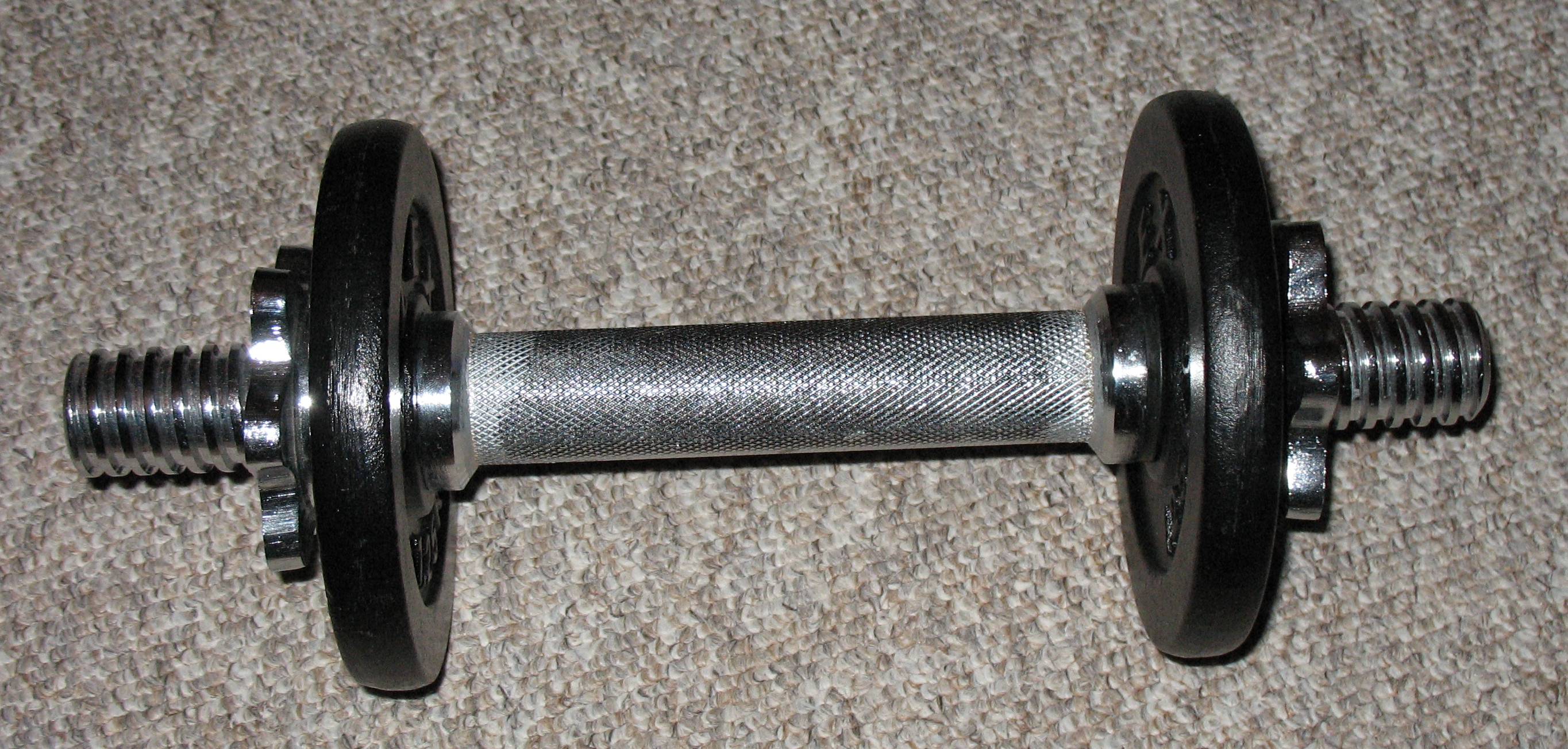
Serious weight training is something you need to be doing if you're serious about martial arts. No serious MMA fighter or martial artist skips weight training. It is absolutely essential to building the strength that helps you throw strong punches and kicks as well as to building strong tendons and ligaments to prevent injury.


    Why do people skip weights? Common arguments are that "muscle slows you down",  This quickly makes no sense when you remember that muscle is what moves your body in the first place. What do these people think - that with less muscle they will somehow be faster? Another argument is "fear of injury". This argument actually has some basis to it, but as with any activity, the risk of injury can be reduced with proper training, proper information, and possibly a good trainer. Another argument is "I hate gym culture". Once again, a valid argument, but open to personal opinion.

                                "But I don't want to go to a gym/I can't afford a gym!!!!"


                        Assuming you are dead-set against lifting weights or going to a gym, there is no excuse as to why you shouldn't be somehow trying to replace that training. What does this mean? You should regularily be doing pushups, pullups, situps, and other bodyweight exercises. You should be increasing the difficulty of these exercises over time in order to compensate for lack of weights. Obvious benefits from this, outside of martial arts, include a healthier lifestyle and burning excess calories.

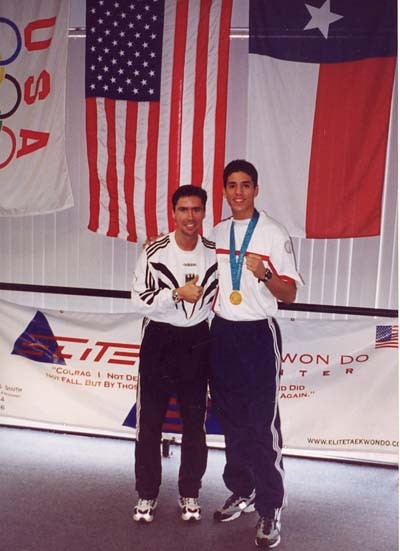
Steven Lopez: Taekwondo Champion

 Steven Lopez is one of the most revered athletes in the martial arts world. Why is he so good?

Steven Lopez trains ruthlessly. What does this mean? He trains every day. His entire family trains in Taekwondo. How often? Every day. Steven Lopez surrounds himself in the art and training of Taekwondo 24/7. It's not for no reason that a single 45 degree roundkick from this athlete puts fear in the hearts of many competitors.


Steven Lopez not only allows himself to learn, but makes it his goal to train his siblings and friends.

This dedication to Taekwondo has lead to this amazing record:


Taekwondo Forms: Why Do We Do Them?

Many students have asked themselves at least once - "Why am I doing this?". For youngsters, Taekwono forms can be boring and repitious. However, that's exactly why they're done.

Are they meant to be realistic? NO.

Are they meant to be strenuous? NO (although, you can make them).

Are they meant to transfer over directly to fighting? NO.


So why are you doing them? Seems like they're worthless, right?
Wrong.


       Although forms teach many things, the most important thing they teach is DISCIPLINE. Learning and repeating forms forces you to have the mental strength and stamina to learn new and unfamiliar techniques in a variety of different situations and patterns.

     Forms also improve individual techniques, stability, and self-control. By self-control we mean control over the body and its motions, as well as breathing. A Taekwondo practitioner should be able to stop his body at any time when doing a technique (an obvious exception would be an aerial technique).

Many make the mistake that forms transfer over directly to fighting. Big mistake. They try to make drills simulating "real fighting situations" and incorporate this into their forms. Yes, the ancient Korean forms were meant for practicing fighting, but they have also changed slowly and surely over a period spanning more than one thousand years. Forms have become more and more artistic and a method for practicing self-control and technique than for preparing for actual combat.


Thursday, July 9, 2015

Top Taekwondo Athletes in the Olympics

Who to watch out for in 2016?

Steven Lopez

Aaron Cook

Jade Jones

Alex Neal

Servet Tazegül
Farzan Ashourzadeh

Nur Tatar

Sohui Kim

Taehun Kim

There are many more, but these will be some interesting ones to watch. As usual, the countries with the most promising athletes in Taekwondo for the 2016 Olympics seem to be: South Korea, the United States, England, Turkey, Iran, Mexico, Nigeria, and various Balkan states.

Friday, October 18, 2013

What Muay Thai Fighters Think of Taekwondo

Muay Thai vs Taekwondo is often a heated debate, as Muay Thai has risen to become the top striking art in MMA. What do Muay Thai fighters think of Taekwondo athletes? Here's a random sample of their point of view, taken from the internet and emails as part of a survey.


Taekwondo sucks and is totally out classed by Muay Thai. I am just kidding.
I have trained for a long time and over the years have ended up training with lots of guys that either had a TKD background as a kid or even a few that were competitive as adults. One thing without a doubt about guys with TKD experience is that their kicks will be fast and powerful. Usually kick exchanges are tricky and they will throw some unorthodox (in terms of Muay Thai) strikes that catch people off guard. I know that I have taken some kicks from the TKD guys I have trained with and incorporated them into my game, spinning back and hook kicks as well as the axe kick in particular.
Guys that I have trained with that are fresh from TKD and don't have MT experience tended to get too hung up on winning the kicking aspect and end up being susceptible to being overrun by punches and clinching. I also found the up high bouncy stance leaves them open to sweeps and throws.
Overall I have had good experiences training with TKD guys. I have a lot of respect for the sport and feel there is much to learn in cross training.


Point sparring. Bleh.


I've had some mixed experiences with Tae Kwon Do fighters. For the most part I've noticed an issue with stance and adaptation. I used to spar with a 3rd or 4th dan (I forgot which) Taekwondo fighter and while his side kicks certainly hurt, close range there wasn't much going on (lacking boxing techniques or even close range kicks for when I cut him off by circling). The side facing stance also made him (and others I've sparred with), very very susceptible to leg kicks. He also got a little too comfortable just tapping me with strikes, he had the power, but didn't put it into action.
Now on the other hand one of the greatest, if not the greatest fighter I've worked, Cyrus Washington, with had an original background in Tae kwon Do. He focused on Muay Thai later on, but his tae kwon do strikes were very unpredictable and really messed me up. That coupled with his base Muay Thai stance, boxing/clinch techniques, and power made for a really difficult combination to deal with.
Overall, I think Tae Kwon Do fighters can be very good, if theres some mixture with other ideas. But most of the Tae Kwon Do fighters I have worked with have been very set in their ways (along with being incredibly cocky) and refused to believe that there was something they could change, even after sparring. This can be a result more so on the part of McDojos rather than Tae Kwon Do itself


Different weapons for a different rule set.Different weapons for a different rule set.

The general perception of tkd in the mt world is that a black belt in tkd is almost as useful in a fight as a PhD in basket weaving.
Wicked kicks yes, but most are impractical, flashy, and inaccurate. 


I did a good eight years of TKD. My instructor was previously a military boxer before he studied TKD for over a decade. This shown in his instruction. We learned the more practical kicks, and hand techniques were just as prevelant as kicking in my dojang. The flashiest that was ever taught was spinning wheel, axe, and leaping kicks (which were more lunging than jumping to cover distance). Boxing stances and techniques were also incorporated as well.
Sparring was a daily occurence in class. The level of contact was based on experience/individuals but usually it was medium to full contact with safety gear (consisting of headgear, gloves, mouthpiece, shinguards, and cup). It was during this time we were taught "The best way to help your partner keep his guard up is to punch him!" It was a cute but true joke as I would learn later: most TKD'ers really don't keep their guard up. We were allowed to utilize whatever we wished during sparring short of elbows, to include the few takedowns found in our style (mostly sweeps and hip throws). It was fun, exhilirating, but most importantly taught us what we would actually be using for self-defense or sport.
When I visited other TKD schools (in USA mind you), the quality of instruction was not so high. I saw black belt children giving orders to those much older. I saw most TKDer's utilize just nothing but kicks with no concept of range. Nothing they did really looked like it had "power" behind it. I saw black belts spar like green belts and the average instructor being horribly out of shape. It was around this time that I realized that this was the standard for TKD in the west. I always wondered growing up why one of my most favorite arts got so much shit, and I was witnessing it with each new school I went to. What seems to be the standard in Muay Thai, boxing, kickboxing, Judo, etc is apparently an exception in TKD. This would pretty much bum me out of martial arts until I found Muay Thai (and even more so, a gym with a similar mindset as my dojang).
Big long-winded story but my point is this: TKD is a valid enough of a striking art to warrant investment in. The problem is finding a decent school/gym. I'm sure with a little research you could find some full-contact TKD gyms that suit the needs of a combative person. As for the professional side, I believe TKD fighter Keiji Ozaki is doing an overall solid job of with proving TKD's worth (Career Record 26W-18L-1D, 9 KOs).

Thursday, October 17, 2013

The Back Kick


What is the Back Kick?


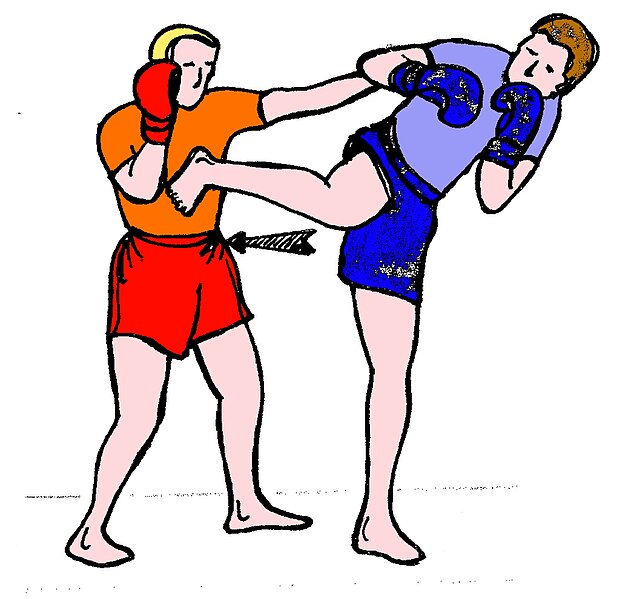
The back kick (뒤 차기 - Dwi Chagi) is much like the side kick taken up to eleven. It is easily the most powerful kick in a Taekwondo user’s arsenal, an excellent move for both offense and defense, and its mastery will make the user a very formidable opponent to anyone they compete against.


Execution


The standard back kick (executed from a fighting/sparring stance) on its most shallow surface is a side kick with an extra step before execution, albeit instead of being delivered in line with your body’s profile it is perpendicular to the profile.  From sparring stance twist so that your back is show to your target , bend and lift up your rear leg so that your heel is at least at your knee height, stop your shoulders from twisting and extend your leg so that the bottom your heel comes in contact with your target at about torso height. If you did everything right you should have executed a crude back kick.


However, crude doesn’t win points, and this simple explanation does not really emphasize where the strength of the back kick comes from: the twist. The reason the back kick (and the back spin kick by the same principle) can completely outclass the side kick in terms of strength is the speed and power the torsion of your hips and shoulders can provide. The hips and shoulders generate immense amounts of rotational energy, all of which gets transferred into linear momentum through the halting of the shoulders. The generation of this rotation begins, like with all spins, the head. Spinning your head around to see your target increases your overall speed as well as ensures you remain on target. Additional torsion is generated by swinging your arms in the rotational direction and then swinging them back mid spin. The halting of the shoulders is exactly what it sounds like; when your back is facing your opponent (after about 180 degrees of rotation) simply lock your shoulders in place while allowing your hips to continue to spin and your leg to extend. Your torso should be collinear with your kicking leg, not your balance leg, but your head should be looking over your shoulder at your target.


Usage


Defense:


The ideal situation for the counter back kick is when your opponent jumps, lunges, dashes, or does any straight motion right towards you.  The reach of the back kick ensures that once they commit to the movement there is no escape. Even if they halt just outside of their kicking range the stretch of your kick should allow you to make solid contact.  But let’s say that you are in the midst of an onslaught of blows and in full retreat. Your opponent is too close for you to fit in a side or front kick and they have too much momentum for a roundhouse kick to stop. A small extra step back into a hopping back kick will stop them dead in their tracks (providing that they are not attacking with pushing kicks and you maintained a good stance during your retreat). Back kick is even a counter to another back kick if you are faster or have longer legs (preferably both) than your opponent.  A less tangible benefit to the back kick is the fear a good back kick user can cause. Catching your opponent off-guard may cause them to become too afraid to make a committed assault.


Offense:


The offensive back kick is a bit trickier. In order to properly execute and offensive back kick you need to force your opponent to move back in a straight line, as opposed to the defensive back kick where your opponent’s motion sets up the kick for you.  This requirement makes the back kick an excellent finisher to a combination. Although it’s a bit more risky, a stepping back kick can be used to close a large distance between you and your opponent. The step in is a fake (or real) roundhouse kick, and if they retreat backwards, chase them with the back kick.  The risk comes in if they decide to dodge to the sides, because if you fail to notice and throw out a back kick you will leave yourself wide open to whatever your opponent wants. On the opposite end of the spectrum, let’s say you are too close to your opponent.  Neither of you are able to kick, yet if one backs the other follows.  From here there are two paths: take a quick back step or use jabs to create the space. Both have the same result, as once the space is created a quick jumping back kick will be hard to avoid.


Final Thoughts


While throwing slow or poor kicks never puts you in a good position, throwing a bad back kick is especially precarious. Besides the large amounts of practice required to mechanically perform the kick, timing is also a key element, the lack of which could turn an otherwise flawless back kick into a perfect opening for your opponent, or worse. Of course this presents a catch-22 of sorts: the only way to get better is to practice but practicing may not make you better because a poorly executed kick may hinder you both physically by getting countered and mentally by not feeling comfortable using the kick. Other kicks do not have this problem as they are easier to use in a probing manner, whereas the back kick requires a full commitment to function properly. Because of this drills are especially important for developing a base confidence level in the back kick.


Drills


DISCLAIMER: As for all kicks, but especially one as powerful as the back kick, there needs to be well-communicated boundaries regarding equipment usage and power. Not everyone may be willing to take a full strength kick even with the proper equipment, especially if there is a drastic size difference between partners. None of these drill require you to slug the target at hard as you can. Real power and effectiveness comes from the technique, not how hard you can kick, so please be considerate when practicing.


Beginner:


These drills are designed to help develop the fundamentals of the technique. They work by isolating key components of the technique so that the individual skills required receive focused attention.


Horse Kick


Equipment:
  • Punching Bag
or
  • Partner
  • Kicking Shield


At the start of this article I framed the back kick in terms of a side-kick variant, and while the sidekick is a very apt comparison for an introduction to the kick, it does not give weight to the differences between the kicks. This drill serves to demonstrate what separates a side kick from a back kick by focusing on the second half of the back kick.


Stand at about arm’s length away from the shield/bag with your back facing the shield/bag and enter a small horse stance. Turn your head over your shoulder to look at the shield/bag while dropping your body down so it is about parallel with the ground and throwing your arms to the opposite side. At the same time your kicking leg (same side as the shoulder you’re looking over) should be brought straight up and then extended straight back in a manner similar to a horse’s kick (hence the name of the drill).


Partner’s Note: Even though your gear is called a shield, you should not try to an immovable wall when kicked, it will hurt. When contact is made don’t tense up, but don’t fall back prematurely either, as an unexpected miss might injure your partner. Simply allow yourself to be pushed as far as your partner pushes, and both of you can continue to practice safely.


Bum Rush


Equipment:
  • Partner
  • Sparring gear or kicking shield


This drill practices the stopping power a back kick can provide by focusing on your weight distribution after the kick, as well as some timing practice. A kicking shield is preferred as it will be more comfortable for the holder but sparring gear will do.


Stand across from the holder about six feet or so, enough that neither of you could touch each other with a fully stretched kick, in fighting/sparring stance or back stance. The holder will attempt to run straight at you and knock you over. When they come close enough, deliver a full back kick to stop them. After contact, your weight should be focused on your kicking foot as you drop it down in front of your target, i.e if you were to try and hold your kicking leg up you would fall forward onto it. If your weight is still focused on your balance leg (or your body is too straight) your kick will be unable to stop your partner and they will knock you back.


Partner’s Note: It is very important that once you start charging you do not stop. A more advanced form of this drill involves you trying to bait out the back kick with fake charges, but once you actually charge you must commit. Be sure to give a brief resting period in between each kick so that your partner can readjust their stance.  


Intermediate:


Once the fundamentals of the technique have been learned, these drills enter the realm of application. The situations provided in the drill are much more alike to an actual sparring match than before, but still controlled in scope.


Open Counter


Equipment:
  • Partner
  • Sparring Gear


This drill helps develop speed and body reading as your reaction must vary with what your partner chooses to do.


Stand at about kicking distance from your partner in an open fighting/sparring stance (open meaning your front leg is the opposite of your partner’s, so left leg and right leg and vice versa. It can also be thought of as having both torsos face the same direction). Your partner has the choice of delivering a normal roundhouse kick, or a jumping front-leg roundhouse kick. If they deliver a regular roundhouse kick, immediately deliver a regular back kick or take a small step back to avoid the kick, and then immediately counter when they miss. If they jump, then you too must jump, but a sparring jumping back is closer to simultaneously switching feet and kicking than it is to an actual jump. Jumping too high will result in a slower kick, meaning you are less likely to get a point for your counter if you are even fast enough at all. It should be noted that the retreating steps are optional as they are not the focus of this drill, but it allows this drill to be a little two-in-one for both stepping and back kick.


Partner’s Note: Again, once you and your partner have reached a comfortable level, adding feints will allow your partner’s reading ability to improve even further.


Closed Counter


Equipment
  • Partner
  • Sparring Gear


This drill is very similar to the open counter drill, except it is a bit more fast-paced due to the difference in allowed kicks.


Just like the open counter, stand across from your partner in a closed stance this time (you should both have the same leg forward i.e left and left or right and right, or your torsos should be in opposite directions). This time your partner’s options are a sliding front leg roundhouse kick or a regular roundhouse kick. When they throw a sliding roundhouse kick, immediately counter with a back kick, this time without steps. However, when they throw a normal roundhouse kick you must step back to avoid it first, and then counter.


Close Jumping Back Kick


Equipment:
  • Kicking bag
or
  • Partner
  • Sparring gear of kicking shield


This drill practices the close range back kick, but also helps develop the coordination required for more advanced spinning techniques (such as 360, 540, 720 etc kicks).


Stand in a small horse stance with one shoulder on or very close to the target so that your body profile is perpendicular to the target. From there, jump with both legs at the same time while turning your head away from the target and deliver a back kick. You should notice that it is very hard to lower your shoulders as you did before in a normal back kick. That is because in spinning techniques your body must remain straight to allow you to stay balanced while you spin. The rotation must be generated from your arms instead. This also makes it more difficult to add power to the kick, and while a jumping back kick will never be as powerful as a standing one, moderate power can be achieved with practice.


Partner’s Notes: As opposed to earlier techniques, try to hold your position more during this drill. Again, do not tense up but try to offer more resistance.


Back Kick Combination


Equipment:
  • Partner
  • Sparring gear or kicking shield

This drill practices the most simple attacking back kick combination. This drill has more advanced applications that will be discussed in the advanced section. A kicking bag can be used instead of a partner in this exercise but will not provide the full benefit that a partner will. This exercise also has benefits to your partner that, should you choose to use the kicking shield, will be lost.


Stand apart from your partner like in the open/closed stance drill. If your stance is open, attack with a regular roundhouse kick. Your partner should attempt to backstep to avoid the kick, after they step drop you kicking leg to the ground and perform a back kick with your rear leg. If your stance is closed the idea is the same, but instead of a normal roundhouse kick deliver a sliding front leg roundhouse kick. To increase your speed when you deliver                                                            the roundhouse kick instead of driving through like a single roundhouse kick, return to the chamber position before putting down your kicking leg. As a side note kicking like this greatly increases speed thus allowing for more kicks in a combination.


Advanced:


These advanced drills now use multiple separate techniques in tandem to fully explore the usage of the technique in sparring scenarios.
Side-Back Kick Combination


Equipment:
  • Partner
  • Kicking shield


This drill practices the combination of two of the most powerful counter-moves: the side kick and back kick. This drill can also be adapted for practicing back spin kick (add a kicking target above the shield.


Stand in a manner similar to the jumping back kick drill, except this time place your front leg on the shield so that it looks somewhere in between a chambered side kick and a fully extended one, tending towards the chamber. Adjust your weight so that the majority is on your balance foot. When ready, turn your head around and drop your front leg back and deliver a back kick simultaneously. The drill is somewhat reminiscent of the horse kick drill in this way. A more advanced form of this drill is to start farther back and have the holder step in to your side-back kick combination.


Partner’s Note: It is especially important not to move during this drill, as you will be supporting some of your partner’s weight and moving may cause them to injure themselves.


Chasing Back Kick Combination


Equipment:
  • Partner
  • Sparring gear of kicking shield


This drill is a more advanced variant of the Back Kick Combination drill. It incorporates advanced stepping techniques to allow you to more closely follow a retreating opponent. As for the back kick combination drill, using a kicking shield or bag will not provide the full experience of the drill, but is still permissible.


This drill is nearly identical the back kick combination drill. The differences are firstly: the starting kick is not important and can be replaced with a fake kick or a step if you choose, and secondly: when delivering the back kick, after your leg is chambered perform a small hop to chase your partner. The hop and kick are not to be delivered simultaneously, however, as that would equate to a switching back kick (a counter move). This hop allows you to cover a greater distance while still maintaining the power of the back kick. It should be noted that the goal of the hop is to cover horizontal distance, not vertical distance.


Summary


Pros:
  • Incredibly versatile
  • Incredibly powerful
  • Very fast with practice
  • Psychological deterrent to attacks


Cons:
  • Easy to avoid
  • Misses leave user exposed
  • Inefficient without practice and experience

Monday, August 12, 2013

Painkillers in Sports

   We've all heard about the use of steroids in assorted sports- but what about painkillers? Painkillers allow the body to go on for longer spurts while ignoring naturally occurring fatigue. While this isn't very popular among most sports that require coordination, such as basketball or soccer, painkillers play a hidden role in combat sports.

Karo Parisyan, recently banned from the UFC, tested positive for large amounts of painkillers in a time period in which he would be fighting competitively. Anderson Silva admitted to taking painkillers prior to a landslide victory over Yushin Okami in UFC 134. What are the benefits of taking painkillers? Fighters can firstly take far more damage and pain than usual. Secondly, fighters can throw with more reckless abandon, having to worry less about leg checks and elbows.

This phenomena is not restricted to professional MMA. It pops up in boxing, kickboxing, and other forms of combat sports. Shockingly enough, this abuse pops up among youth in Karate and Taekwondo tournaments. At a young age, I was personally offered the standard 3-4 Advils, an unhealthy amount for a child, before fights at local Taekwondo tournaments. While I never took them, I witnessed other children smashing knees and elbows without so much as batting an eye while  hopped up on painkillers. While not widespread, the use of painkillers among child athletes is common enough that it should be a cause for worry. This mixture of adrenaline and drugs can lead to some "mystery" and serious injuries that are only realized after the competition is over.


Thursday, June 20, 2013

Taekwondo Punching Technique

The punch (Jireugi) in Taekwondo is different from that of some martial arts. The way the fist is formed is relatively the same and consists of the basic wrapping of the thumb around the curled up fingers. The real difference in comparison to, say, boxing, is the matter in which the punch is thrown.


  Taekwondo as a whole is mostly centered around kicking, so punches are not generally used in an offensive manner. Instead they are thrown from a defensive position if the opponent has gotten too close. A defensive position usually indicates a rooted base without too much movement. Therefore, punches in Taekwondo are thrown with little, if any, rotation, movement, or pivoting of the legs or feet. The power generated comes from the rotation of the upper body and the final twist of the wrist. This theory can be seen in punching drills practiced in the horse riding stance (Annun Sogi), where the upper body and arms are the instruments of movement, while the legs stay firmly rooted to one spot.

                       What are the advantages and disadvantages of this method?


Pros:
  • Steady base allowing for a quick transition towards attacking the opponent with kicks
  • A solid position that allows better coping with leg kicks and allows for checks without compromising position
  • A tight guard 
  • Discourages overextending/reaching too far to hit your opponent with your punches
Cons:
  • Noticeable lack of power compared to boxing technique  
  • Noticeable lack of speed compared to boxing technique
  • Diminished reach of punch